
Greta Hayes · 8 October 2026
Navigating Data Synchronization Hurdles in Emerging Professional Ecosystems During Multi-Tool Adoptions
Emerging professional ecosystems now rely on layered combinations of project management platforms, customer relationship systems, analytics dashboards, and communication suites that must exchange information in real time, yet data synchronization failures continue to surface whenever organizations expand their tool stacks without coordinated mapping protocols. Researchers tracking enterprise deployments note that mismatches in data schemas, timing conflicts, and access permission layers create friction points that slow workflow continuity and increase error rates across departments.
Core Synchronization Challenges in Multi-Tool Environments
Compatibility gaps appear when one application stores timestamps in UTC while another defaults to local server time, and observers tracking these patterns report that such discrepancies compound during peak collaboration hours when multiple users update shared records simultaneously. Security protocols add another layer because encryption standards differ between tools, forcing middleware solutions to handle translation tasks that introduce latency measured in seconds rather than milliseconds. Data volume spikes during quarterly reporting cycles push synchronization queues beyond designed thresholds, and figures from October 2026 show increased incident logs at organizations that scaled tool adoption without capacity testing beforehand.
Permission conflicts arise when role-based access controls in one system do not align with granular field-level permissions in another, leaving certain records visible in one interface but locked in the connected platform. Those who manage cross-platform migrations document cases where partial syncs left duplicate entries that required manual reconciliation over several days, diverting analyst time from strategic tasks.
Patterns Observed Across Growing Professional Networks
Studies of mid-sized firms reveal that teams adopting four or more specialized tools within a twelve-month window encounter synchronization drift at rates nearly double those seen in environments limited to two primary systems. The drift often stems from API version mismatches that occur after individual vendors release updates on staggered schedules, and developers must then rebuild connectors to restore consistent data movement. One documented rollout at a consulting network demonstrated that automated reconciliation scripts reduced manual corrections by forty percent once field mapping rules were standardized across all connected applications.
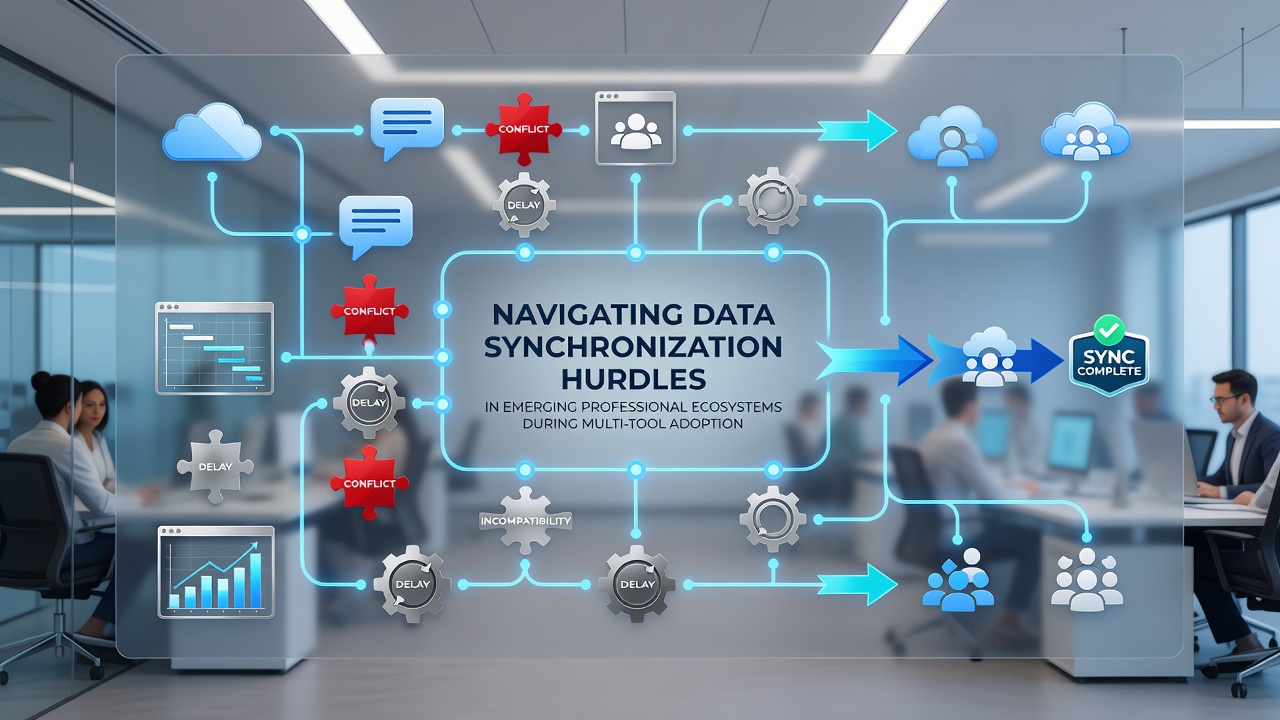
Latency issues surface most visibly in global teams where users operate across time zones, because batch synchronization windows chosen for one region often fall during active hours in another, leading to stale views that affect decision accuracy. Research indicates that organizations implementing continuous synchronization streams rather than scheduled batches report fewer instances of conflicting record versions, though this approach demands higher baseline bandwidth and monitoring resources.
Approaches That Reduce Integration Friction
Implementation of canonical data models allows each connected tool to map its native structure to a shared reference format, and evidence from integration projects shows this method cuts reconciliation time significantly compared with direct point-to-point mappings. Middleware platforms that log every transformation step provide audit trails useful for diagnosing where data diverges, while change detection algorithms flag anomalies before they propagate across the ecosystem. According to findings published by the National Institute of Standards and Technology, organizations that adopt standardized metadata schemas experience fewer permission-related sync interruptions during multi-tool expansions.
Training programs that emphasize data stewardship responsibilities across tool boundaries help teams anticipate conflicts before they reach production environments, and professionals who maintain living documentation of field definitions report faster resolution when new applications join the stack. Australian Government digital economy analyses highlight that firms investing in pre-adoption compatibility audits reduce post-launch synchronization incidents by measurable margins compared with those proceeding without such reviews.
Conclusion
Successful navigation of data synchronization hurdles in expanding professional ecosystems depends on structured mapping, continuous monitoring, and proactive alignment of update cycles across all adopted tools. Organizations that treat synchronization as an ongoing operational function rather than a one-time setup step maintain higher data integrity as their technology landscapes evolve.